
Robotic welding is no longer limited to high-volume production lines and large industrial robots. Collaborative robots are making welding automation accessible to a much wider range of manufacturers - including applications where space is limited, production changes frequently, or components are difficult to reach.
But welding also highlights one of the fundamental challenges of robotic automation: reaching the right position is only part of the task. The robot must also approach the weld at the correct angle, follow the required path, and navigate around the workpiece, fixtures, and other obstacles.
This is where an additional degree of freedom can make a significant difference.
Kassow Robots cobots are designed with seven axes rather than the six traditionally found in many industrial and collaborative robots. For welding applications, that seventh axis provides additional maneuverability that can help manufacturers automate tasks that would otherwise require workpiece repositioning, more complex fixtures, or additional equipment.
Why flexibility matters in robotic welding
Welding places very specific demands on a robot.
The torch needs to reach the weld while maintaining the required orientation and travel speed. At the same time, the robot may need to work around clamps, fixtures, and previously welded sections of the component.
The challenge becomes greater when parts have complex geometries or the welding cell itself has limited space.
A traditional six-axis robot has six degrees of freedom to find the required position and orientation. Adding a seventh joint gives the robot another way of configuring its arm while maintaining the required tool position.
Think of it in a similar way to the human arm: you can keep your hand in approximately the same position while moving your elbow. That extra freedom can be extremely useful when trying to reach around an object or work within a confined area.
For a cobot, this creates more options for finding an efficient path to the weld.
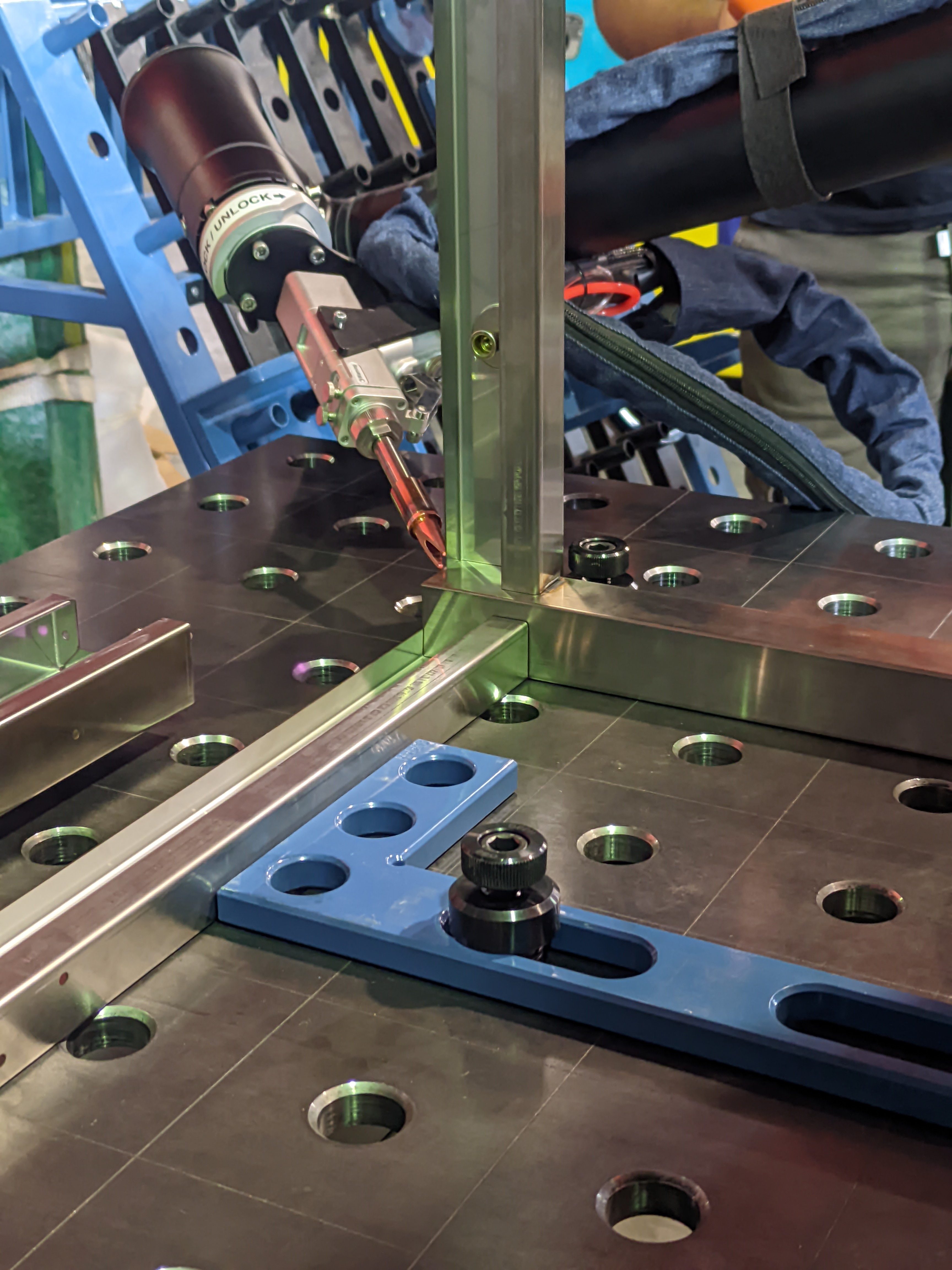
Reaching around the workpiece
One of the practical benefits of seven-axis kinematics is the ability to approach a workpiece from different directions.
Consider a component that requires welds on several sides. Depending on the geometry and robot setup, a six-axis solution may require the component to be repositioned so the torch can reach each weld with the required orientation.
Repositioning introduces another step into the process. It can require operator intervention, a positioner, or additional automation equipment - all of which can increase the complexity of the welding cell.
The seventh axis gives the robot greater freedom to change its arm configuration as it moves around the component. In suitable applications, this can allow multiple sides of a workpiece to be reached from a single setup.
Fewer repositioning steps can mean a simpler process, fewer interruptions, and potentially a more compact automation concept.
Navigating fixtures, clamps, and confined spaces
The workpiece itself is only one part of the challenge.
Welding cells typically contain fixtures, clamps, tables, extraction equipment, and other components that the robot must work around. A robot may theoretically have enough reach to access a weld, but the configuration of its joints can prevent it from getting there without interfering with something else in the cell.
Seven-axis motion provides an additional option.
The robot can change the position of its elbow while maintaining the tool center point, helping it find alternative configurations around obstacles. This capability is particularly useful when automation needs to be introduced into an existing workspace rather than designing an entirely new production cell around the robot.
It also supports one of the broader advantages of lightweight cobot automation: achieving more within a relatively small footprint.
Maintaining the right welding position
Reach alone does not create a good weld.
Torch angle and travel speed are among the parameters that influence welding quality. The robot therefore needs to follow the required path while maintaining the programmed orientation of the torch.
Complex contours can make this more challenging. As the robot moves from straight sections into curves or around corners, its joints must continuously adjust while keeping the torch on the required trajectory.
The additional degree of freedom gives the motion planner more possibilities for coordinating those movements.
Rather than simply asking whether the robot can reach a point, manufacturers can therefore consider a more important question:
Can the robot reach the entire welding path in the required orientation while working around everything else in the cell?
Research into redundant robotic manipulators for welding has similarly explored how additional degrees of freedom can improve maneuverability, reachability and obstacle avoidance in complex welding environments.
Automation that starts with welding knowledge
Flexibility is not only about robot kinematics. The people using the system also matter.
For many small and medium-sized fabrication businesses, introducing robotic welding cannot depend on having a robotics specialist permanently available on the shop floor. The people who understand the application best are often the welders themselves.
Modern cobot systems help bridge this gap by making programming more accessible.
With Kassow Robots, operators can manually guide the robot to required positions and create points along a path. Welding parameters and robot movements can then be incorporated into the application through the robot interface and the wider welding system.
This allows the knowledge of experienced welders to remain central to the process. Automation can take over suitable repetitive operations, while skilled personnel can concentrate on welding tasks that require their experience, judgment, and adaptability.
Designed for integration
A welding robot rarely works alone.
A complete solution can include the welding power source, torch, wire feeder, fixtures, safety equipment, and potentially additional sensors or peripherals. The ability to integrate these components is therefore an important part of developing an effective robotic welding cell.
Kassow Robots cobots are designed as an open platform for integration, enabling system integrators and automation specialists to build welding solutions around the requirements of a particular application.
This is especially relevant in environments where manufacturers already have welding equipment in place and want to introduce automation without unnecessarily rebuilding the entire process.
From theory to the welding cell: Spartan Robotics
The advantages of seven-axis movement become easier to understand when applied to an actual welding system.
Spartan Robotics, a division of BlueBay Automation, develops collaborative robotic welding solutions and integrated Kassow Robots technology into its Spartan welding cell after evaluating different robotic platforms.
The company identified confined spaces, complex weld paths, and obstacle avoidance as important challenges for robotic welding. In these environments, simply having sufficient robot reach was not enough - the robot also needed the maneuverability to reach difficult areas while navigating around the surrounding equipment.
By incorporating a Kassow Robots seven-axis cobot, Spartan Robotics was able to use the additional joint freedom to address difficult-to-reach welding positions and complex paths within the cell.
The application demonstrates an important principle for robotic welding: flexibility is not determined by reach alone. How the robot can use that reach can be equally important.
Making welding automation more adaptable
For manufacturers considering welding automation, the goal is not necessarily to automate every weld.
Instead, automation can be used strategically.
Repetitive operations can be assigned to the robot, helping provide repeatable motion and predictable production while allowing skilled welders to focus their time where their expertise creates the greatest value.
This becomes particularly important as manufacturers deal with changing product mixes, smaller batch sizes, and continued pressure on the availability of skilled labor.
Flexible robotic systems can help companies respond without committing every application to a large, permanently configured automation cell.
And when the robot itself can reach around obstacles, work from different orientations, and adapt to confined production environments, the range of potential applications becomes considerably wider.
The seventh axis is more than an extra joint
Adding another axis may sound like a small difference in robot design.
In practice, it changes the number of ways the robot can position itself around a task.
For welding, that can translate into the ability to navigate around fixtures, maintain the required torch orientation, reach multiple sides of a component, and operate effectively in spaces where conventional robot configurations may be restricted.
As manufacturers look for ways to automate increasingly complex and variable welding processes, that additional flexibility can open the door to applications that were previously difficult to automate.
In welding and beyond, the seventh axis opens new possibilities for automating applications where reach, maneuverability, and flexibility matter most.
See the next generation of 7-axis cobots in action
The flexibility of seven-axis motion extends far beyond welding. See how the latest Kassow Robots models combine 7-axis maneuverability with increased payload, extended reach, and upgraded performance to open new possibilities for demanding automation applications.
Originally featured in Welding Productivity
This article was adapted from “Multi-Axis Revolution,” originally published by Welding Productivity / FSMdirect and written by Collin Ayres. The original feature explores the use of Kassow Robots’ seven-axis technology in welding applications, including its integration by Spartan Robotics.
Read the original article on FSMdirect →
