
Robotics is entering another period of rapid change. Advances in artificial intelligence, perception, motion planning and robot hardware are bringing increasingly capable systems from research environments into factories.
Much of the current attention is focused on humanoid robots: machines designed around the general proportions and movement capabilities of the human body. The International Federation of Robotics (IFR) describes the long-term vision as creating general-purpose robots based on human motion mechanics, while also emphasizing that significant technical and economic questions remain before broad industrial deployment becomes a reality.
But humanoids are not the only path toward more autonomous and flexible production. Another approach combines a mobile robotic platform with one or more collaborative robot arms. With two arms, such a system can provide mobile, bimanual manipulation while using wheels rather than legs to move between production areas. Both concepts aim to bring automation to the work rather than permanently fixing automation in one location. But they approach the challenge from very different directions.
Why humanoid robots attract so much attention
The appeal of humanoid robots is easy to understand.
Factories, warehouses and other workplaces have largely been designed around people. Workstations, shelves, tools, doors and material flows therefore naturally correspond to human dimensions and capabilities. This is one of the arguments behind humanoid robotics: a robot with a human-like form could potentially operate within existing environments with fewer changes to the surrounding infrastructure.
The IFR specifically identifies this compatibility with human environments as one of the reasons for growing interest in humanoids.
The long-term ambition is significant. A sufficiently capable humanoid could potentially move between areas, manipulate different objects and tools, and perform tasks that today require several separate automation solutions.
However, recreating human mobility also introduces considerable engineering complexity.
Replicating human movement is a difficult engineering problem
Walking looks effortless when humans do it. For a robot, it means continuously coordinating sensing, balance, motion and control.
A humanoid designed for industrial environments may have to combine locomotion, stabilization, obstacle avoidance, object detection, manipulation and interaction with its surroundings simultaneously.
Fraunhofer IPA's recently introduced benchmark for humanoid robots reflects this complexity. Rather than evaluating only whether a robot can complete an impressive demonstration, the institute assesses areas including basic capabilities, complex motion, functional safety, cybersecurity and energy efficiency.
The benchmark also illustrates the distance that can exist between demonstration capability and practical industrial operation. In tests of one current humanoid platform, Fraunhofer measured operating time of approximately 1 hour and 49 minutes in a scenario combining standing and walking, while also identifying safety and cybersecurity considerations that would have to be addressed for industrial applications.
These findings do not mean humanoids are unsuitable for manufacturing. They highlight something more important: industrial robots must ultimately be evaluated against the requirements of the application, not simply their form factor.
An alternative approach: bring the arms to the work
For many production tasks, walking may not be required at all.
Manufacturing operations commonly involve moving components, loading machines, handling tools, assembling parts, inspecting products or transferring material between processes. If the factory floor is relatively structured and accessible to wheeled vehicles, mobility can instead be provided by an autonomous mobile platform.
Adding robotic arms to a mobile base is already an established field of robotics research. Reviews of mobile manipulation describe how mobile platforms can be combined with serial manipulators to extend their working area and allow one robotic system to perform manipulation tasks at multiple locations.
More recent research has demonstrated industrial mobile manipulators capable of autonomous navigation, precise docking and subsequent object handling.
With two collaborative robot arms, the concept goes one step further.
Instead of attempting to recreate an entire human body, a dual-arm mobile system combines the mobility required to travel between processes with the manipulation capability required when it arrives.
.jpg)
Why two arms?
Humans frequently use both hands together, and many manufacturing operations have the same requirement.
One arm may hold or reposition a component while the other performs an operation. Two arms can also coordinate during handling, transfer objects between them or work simultaneously on different parts of a process.
For mobile automation, this can be particularly valuable because the objective is often to create a system capable of servicing multiple types of workstation rather than optimizing a robot for one permanently fixed operation.
There is another advantage when seven-axis collaborative robots are used. The additional joint provides greater freedom of movement around obstacles and within constrained workspaces - an important consideration when two robot arms, a mobile platform and existing production equipment all have to share a relatively compact working area.
For Kassow Robots, this is where the concept becomes particularly interesting: mobility from the platform, manipulation from two seven-axis cobots, and additional flexibility from their kinematics.
Wheels and legs solve different mobility problems
The most visible difference between these concepts is also one of the most fundamental: locomotion.
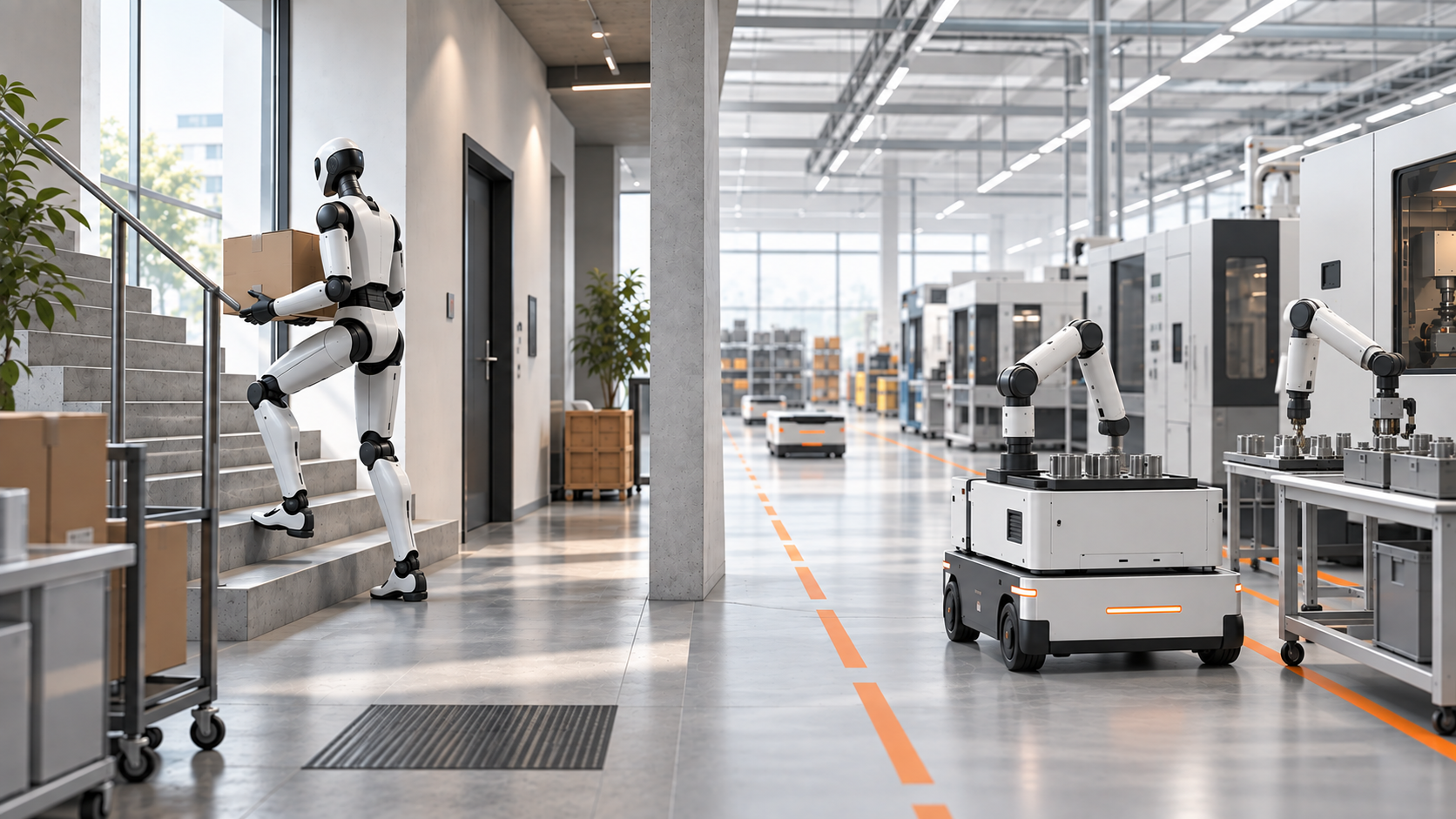
Humanoid robots use legs partly because they are intended to navigate environments created for people. Stairs, thresholds and uneven surfaces are situations where legged locomotion can provide a meaningful advantage.
A wheeled mobile manipulator makes a different engineering trade-off.
On a typical production floor, where robots move between machines, assembly stations, conveyors and logistics areas, a mobile base can provide efficient transportation without requiring the robot to continuously maintain dynamic balance.
This does not make wheels inherently superior to legs. It means each architecture has environments where its advantages are more relevant.
Fraunhofer's humanoid benchmark, for example, specifically evaluates walking speed, stair climbing, obstacle navigation and stability on different surfaces - capabilities that demonstrate why legged mobility is both powerful and technically demanding.
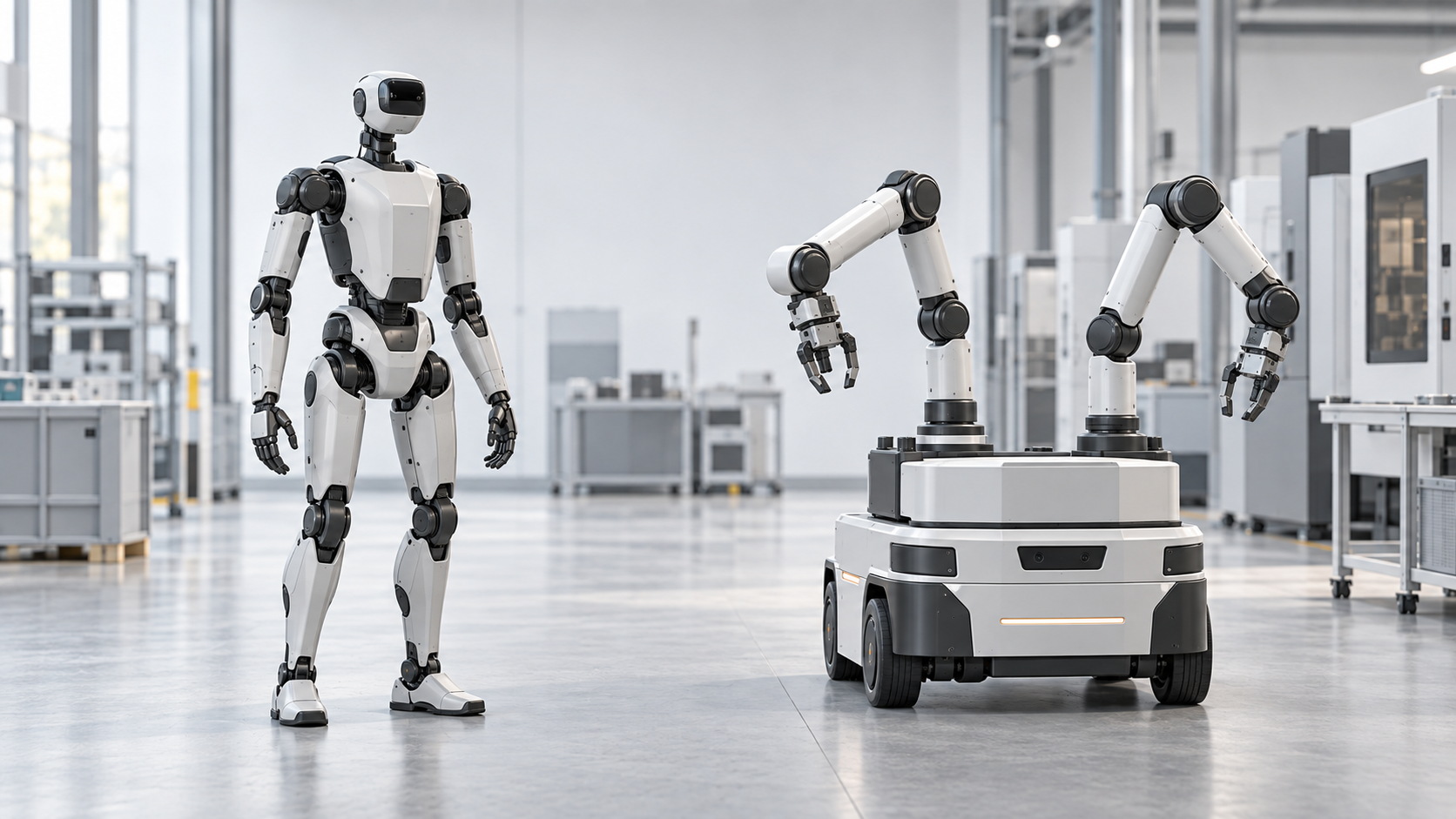
Stability becomes especially important during manipulation
Mobility is only half of the challenge. Once a robot reaches a workstation, it must perform useful work.
This can require accurate positioning, repeatable robot trajectories and, depending on the application, controlled interaction with tools, fixtures and machines.
Mobile manipulation research therefore places considerable emphasis on localization and precise docking before manipulation begins. Research into autonomous industrial mobile manipulators, for example, has demonstrated systems combining navigation with precise dynamic docking and subsequent object handling.
A mobile base can consequently be optimized around transportation and stable positioning, while the robot arms are optimized around manipulation.
This division of responsibilities is fundamentally different from a humanoid architecture, where locomotion, balance and manipulation form part of one highly interconnected system.
Designed around the factory task
This leads to perhaps the most important distinction between the two approaches.
A humanoid starts with the question:
How can a robot operate in an environment designed for a human?
A mobile manipulation platform starts with a somewhat different question:
What combination of mobility and manipulation is needed to automate this process?
For manufacturers, that distinction matters.
The ultimate measure of an automation system is not how closely it resembles a person. It is whether it can perform the required process reliably, safely and economically.
That means considering factors such as:
- payload and reach
- cycle time
- positioning accuracy
- available floor space
- safety requirements
- uptime
- energy consumption
- integration with machines and production systems
- ease of redeployment
This application-focused evaluation is also increasingly being applied to humanoids. Fraunhofer describes the need to move from media demonstrations toward standardized assessment of actual capabilities and industrial suitability.
Where humanoids could have a real advantage
There are nevertheless applications where human-like mobility could become particularly valuable.
Facilities containing stairs, narrow passages, obstacles or environments that cannot practically be redesigned for automation are obvious examples. Humanoids may also eventually prove useful where the same robot must perform an exceptionally broad range of tasks using infrastructure and tools originally created exclusively for people.
The IFR sees this general-purpose capability as a central part of the humanoid vision, while noting that questions around reliability, energy efficiency, maintenance, cost and standards remain important considerations.
The technology is advancing quickly, and its long-term industrial potential should not be underestimated.
What about safety?
Whatever the robot's shape, flexible automation operating around people must address safety at the complete system level.
Collaborative robot systems already operate within established industrial robot safety frameworks such as ISO 10218 and ISO/TS 15066. Research into physical human-robot interaction continues to examine how collision forces, robot energy and control strategies influence the balance between safety and robot performance.
Humanoid robots introduce additional considerations because mobility and whole-body stability become part of the safety equation. Fraunhofer's humanoid benchmark therefore includes tests covering stability, collision forces, obstacle detection and system behavior during failures.
For both technologies, safety is ultimately application-specific and must be assessed for the complete robotic system and its intended operating environment.
Humanoid or mobile manipulator: which comes first?
For manufacturers evaluating automation today, the answer does not necessarily have to be one or the other.
Humanoids represent an ambitious route toward highly general-purpose robotics capable of operating within environments originally designed for people.
Mobile manipulation takes another route: combining autonomous mobility with robotic manipulation technologies that are already familiar within industrial automation.
The latter is not intended to imitate a person. It is designed to provide the capabilities required by the process.
And that distinction could become increasingly important as manufacturers seek automation that is not only flexible, but deployable.
The future does not need a single form factor
The future factory is unlikely to be populated by just one type of robot.
Fixed industrial robots will continue to make sense for high-volume processes. Collaborative robots will remain useful where flexibility and compact automation are priorities. AMRs will move materials through factories. Mobile manipulators can combine transportation and physical interaction with machines and components.
And humanoid robots may eventually add another category - particularly where operating within human-designed environments provides a genuine advantage.
The more interesting question therefore may not be:
Will factories use humanoid robots?
It may be:
How much of the capability promised by humanoids actually requires a humanoid form?
For many structured manufacturing environments, flexible automation may not need legs at all.
Sometimes, the more direct path is simply to bring the arms to the work.
