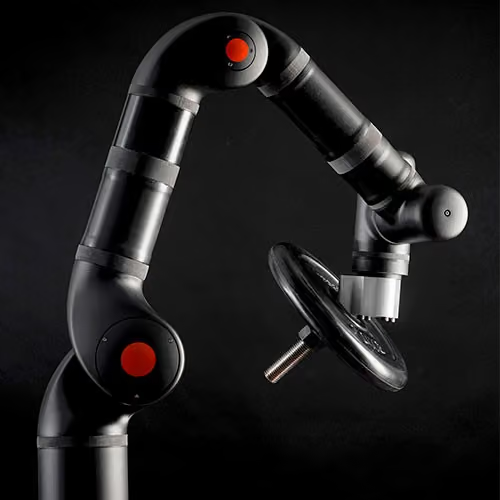
At Greek cheese producer Epirus S.A., the cases arriving at the end of the line were open-top feta cartons, and there was little room for a new palletizing station. Systems integrator Netelco fitted a Kassow Robots KR1410 alongside a Bosch Rexroth VarioFlow conveyor and developed a gripper that takes the cartons from the side. The cobot stacks 11 layers of 33 boxes on each Euro pallet, placing a cardboard sheet on top of each layer.
That installation illustrates where to start on an existing line. The case determines how you grip it, the pallet pattern determines where the arm has to go, and the rate of incoming cases determines how much time the cell has. The same checks apply whether you’re stacking food and beverage cases, personal care products or household goods after case sealing and labeling.
Start with the cases and pallet patterns
Give your integrator actual production samples, including the lightest and heaviest cases and any formats that arrive open, slightly deformed or off-center. A sealed carton with a suitable suction surface may work with a vacuum gripper. An open-top case may call for side gripping, as at Epirus. Test each format with the intended gripper and infeed, including how the cell detects and recovers from a missed pick.
For each product, record the pallet size, stacking pattern, maximum loaded height and any interlayer sheets. If the line runs several SKUs, decide how operators will select the right recipe and restart after an interruption. At Automate 2026, Kassow demonstrated a KR1824 cell with a Bosch Rexroth conveyor and a gripper that generated vacuum at the tool. The demo software generated the program from the box dimensions, pallet dimensions and stacking pattern. See the KR1824 in action at Automate and read the show-floor coverage.
Check reach and payload with the gripper in place
Mark the conveyor pick point and the pallet positions on the floor plan. Can the loaded gripper reach the far corner on the first layer? Can it approach the highest layer and withdraw without clipping the stack, conveyor or nearby equipment? A seventh axis gives the arm more options for positioning its elbow while maintaining the required tool orientation. That matters when the gripper can reach the target but the arm has limited room to move around the equipment.
The KR1824 has 1,800 mm of reach and a rated payload of 24 kg, making it a candidate when reach to the farthest placement drives the layout. The KR1240 has 1,200 mm of reach and a rated payload of 40 kg, making it a candidate for heavier loads within a shorter working envelope. Count the cases, gripper and mounting hardware in the total load. Then check the load’s center of gravity and the robot’s limits for the planned motion. If stack height is the constraint, compare a longer-reach arm and a lift-column configuration in the actual layout. Compare the KR1824 and KR1240.
Plan for pallet exchanges and check the rate over a full run
Map how empty pallets arrive, how full ones leave and where operators access the cell to clear a jam. A second pallet position may give the robot somewhere to keep stacking during an exchange. An accumulation conveyor can hold incoming cases during a short stop if there’s room and the cell can catch up afterward.
For example, if cases arrive at 10 per minute and stacking pauses for a 45-second pallet exchange, about eight cases will need somewhere to wait if the infeed keeps running. Once stacking resumes, the cell needs enough spare capacity to clear that backlog before the next interruption. Check throughput over a representative run with real cases, including interlayer sheets, pallet exchanges and routine stops. Use the sustained line rate and the duration of short peaks to size the cell and its buffer.
Assess the complete application, including the gripper and load, dropped cases, pinch points, pallet exchanges and nearby traffic. Use the risk assessment to determine safeguarding, then validate throughput with those measures in place. See ISO 10218-2 for industrial robot applications and cells.
Can one cell serve more than one line?
If two lines run at different times, a relocatable palletizer may be worth evaluating. WEPALL’s Kassow Palletizer, for example, can be moved by pallet jack or forklift. Check how the cell will be positioned, connected and safeguarded at each line, and how long it takes to get back into production after a move. Explore the WEPALL Kassow Palletizer.
Discuss your palletizing application
Share your case dimensions and weights, pallet formats, target stack height, line rates and a simple floor plan. Kassow Robots and its integration partners can help assess the reach, tooling and cell layout for your line.
For a broader introduction to palletizing automation, see our Palletizing Robotics Guide.
